




The first storm forecast of the season is the moment most Brisbane homeowners actually look at their outdoor unit — and wonder whether there is anything they should do to it before the weather arrives. There is. Split system storm prep is a short, specific list of external checks and one booked inspection, done in September rather than during a warning, and almost all of it is about the outdoor unit, not the indoor head.
This page covers the work in the order it should actually be done: timing first, then the physical checks a homeowner can do from the ground, then the one job that belongs with a licensed technician before the calendar fills up.
Why September, Not October
Brisbane’s storm season runs October through March. The check window is the four to six weeks before it starts, not the week a severe weather warning is already on the radio. Once a warning is active, the task changes from preparation to making safe, and nobody should be climbing a ladder or opening an outdoor unit in wind and rain.
The practical consequence: if you ring an installer in November about an outdoor unit that has shifted on its brackets or is leaking condensate into the ceiling, you are ringing during the busiest weeks of their year. Booking the same job in September means the work gets done, and the diagnostic is calmer. This is the single timing rule that the rest of the list depends on.
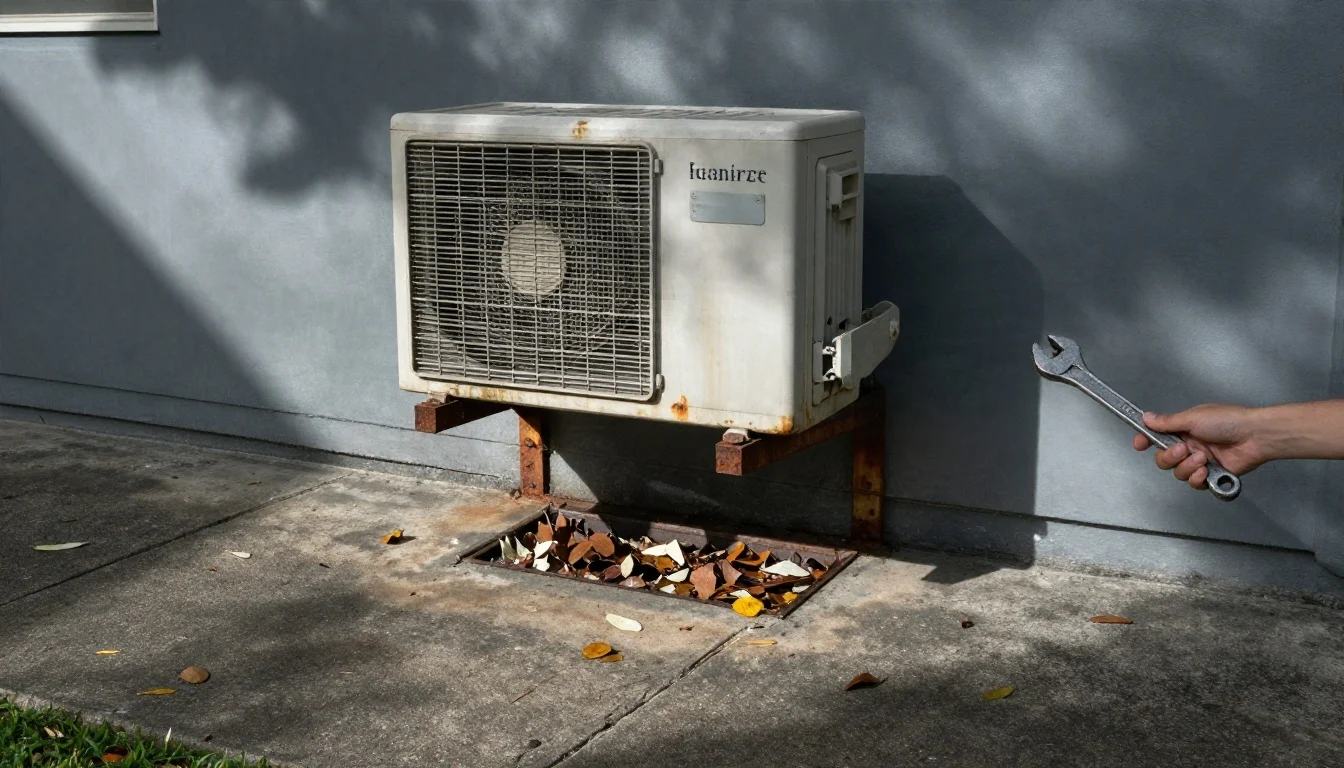
Mounting, Brackets and Clearance
The outdoor unit sits on either wall brackets or a ground pad. Either way, it carries the full weight of the compressor and a coil assembly, so the mounting is the first thing a storm is going to test.
What to Look For on the Brackets
Stand at ground level and look up at the unit from three angles. You are checking for:
- Visible rust on the brackets, especially where they meet the wall plate.
- Bolt heads that no longer sit flush — a loose bolt shows as a turned or projecting head.
- Wall anchors that have crept out of the masonry or timber, leaving a gap between bracket and wall.
- The unit itself sitting slightly out of level, or further off the wall than it was a year ago.
Any of these means the unit has moved, and a storm will move it further. This is the point to book the technician — not to climb up and tighten anything yourself.

What Should Not Be Touching the Unit
After a winter of gardening, the area immediately around the outdoor unit is rarely what it was at install. Walk the full perimeter and confirm the unit still has clear airflow:
- No garden growth is pushing against the coil — vines, palm fronds and bushy shrubs creep in over the dry months.
- No stored items are stacked against the unit — pots, bins, kids’ toys and pool equipment are the usual culprits.
- Leaf litter has not built up under or behind the unit — wet leaves against the coil are the standard cause of the “smells damp when it starts” complaint later in summer.
Drainage Is the Real Rain Threat
The outdoor unit itself is built for weather. Its electrical enclosure is sealed, its coil is aluminium, and it is designed to sit in the rain. The component that is not built for a Brisbane downpour is the condensate drain line — a small PVC pipe that runs from the indoor head out to the outdoor unit and drips onto the ground.
Where the Line Should Discharge
The drain outlet at the outdoor end should drip onto free-draining ground — garden soil, gravel, or a stormwater grate — not onto concrete that slopes back toward the house, not into a garden bed that holds water, and not directly against the slab. If the discharge point now sits over paving that has settled, or a garden bed that has built up over the years, water has nowhere to go during heavy rain.

Clearing a Slow Drain
A drain that has silted up over the winter shows as algae crust or a slow dribble rather than a steady drip. The visible outlet should be checked, but any blockage inside the pipe is a technician job — and it is the job that prevents the first summer ceiling stain from appearing above the indoor head.
Power, Surge and the Switchboard
Storms in Brisbane usually mean a power outage, and outages usually mean a brief surge when supply returns. The pre-season question is whether the unit is on a protected circuit.
Two checks at the switchboard before the season:
- Confirm the outdoor unit has its own dedicated circuit breaker, and that the breaker is labelled so you know which one it is.
- Press the RCD test button (the one marked T or Test) on that circuit. The breaker should trip immediately. Reset it. If it does not trip, the RCD has failed and needs replacing — book it now, not after the first outage.

Clear the Projectile Zone
The single biggest physical risk to an outdoor unit in a Brisbane storm is not wind or rain. It is the loose object in the yard that becomes airborne — a pot plant that has dried out and lost its soil, a trampoline with no tie-downs, a sheet of roofing iron that was never fixed down properly, a shade sail with a frayed corner.
The prep task is a slow walk around the yard with a storm in mind:
- Tie down or move every movable object in the wider flight path of the outdoor unit.
- Look directly above the unit — anything overhead that could come down onto it (loose guttering, a rotted fascia board, an unsecured awning) is a September repair, not a November one.
- If there is a trampoline in the yard, anchor it or disassemble it.
What Belongs With a Technician
The line between what a homeowner does and what a licensed installer does is straightforward and worth drawing before the season starts.
Homeowner, from the ground: visual checks of brackets, clearance around the unit, the drain outlet, the yard for loose objects, and the RCD test button at the switchboard.
Licensed technician: anything involving opening the electrical enclosure, touching refrigerant connections, working at height on the unit itself, a unit that has visibly shifted on its brackets, a drain blockage beyond the visible end, or an RCD that fails the test.
The reason to draw the line this clearly is that most of the damage seen after a storm started before the storm — a bracket that was already loose, a drain that was already slow, a switchboard that was already marginal.

Book the Pre-Season Outdoor Check
If you want the mounting, drainage and electrical isolation of your outdoor unit checked by the same licensed hands that would install a replacement, ring 0420 718 827 and book a pre-season outdoor check. September and early October slots fill before the season peaks, so booking early is the point. A short service now is the difference between an October storm and an October repair bill.
